

China Just Extended Zero-Tariff Access to Bangladesh Again — But Freight Rates Are Rising at the Same Time
China's 2026 tariff schedule keeps Bangladesh's zero-tariff and preferential access in place — good news on the duty side. But China-to-Chittagong freight rates jumped sharply in the same window, with FCL up 9–18% in a single month. Here's why tracking both matters before you price your next shipment.
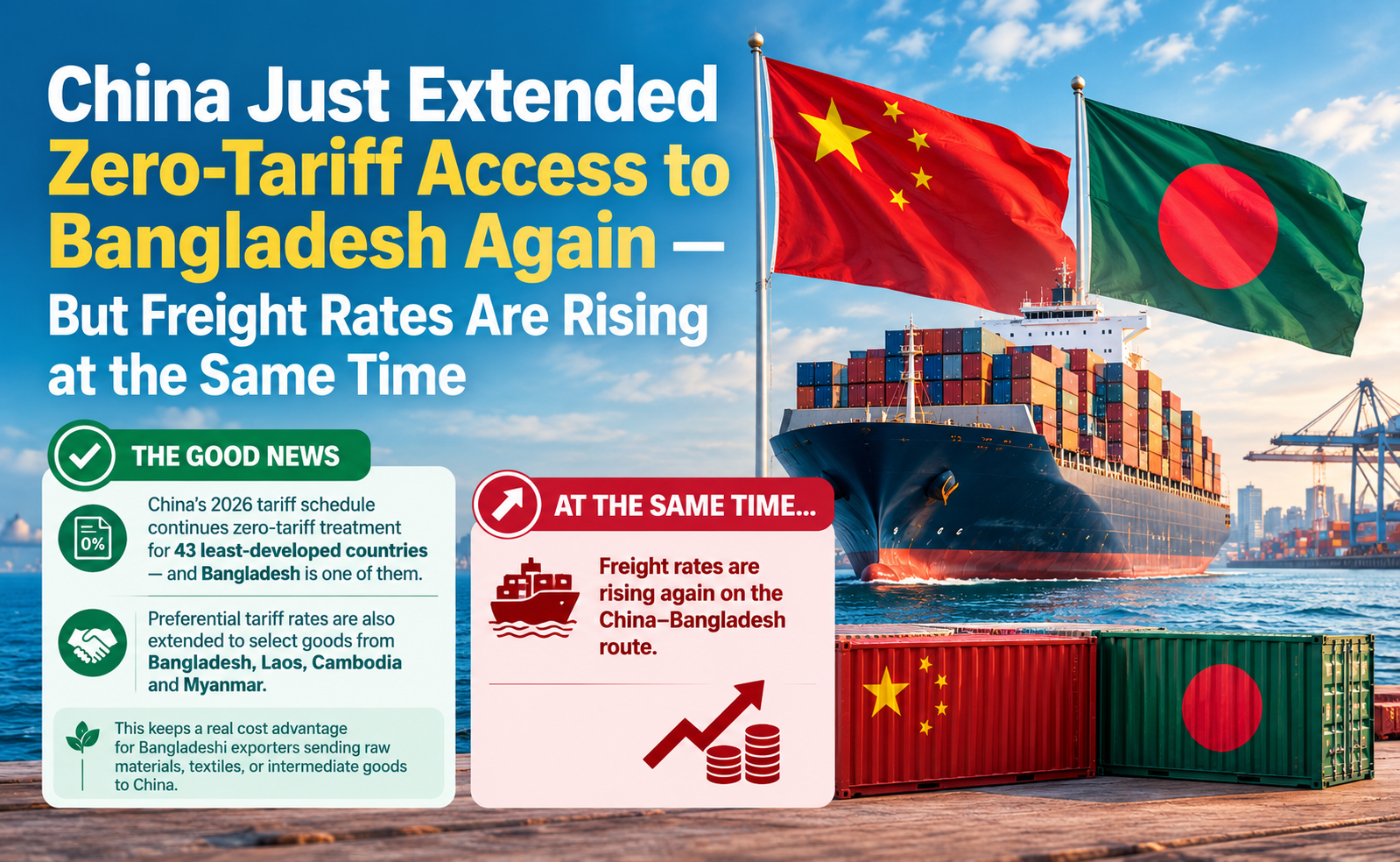
China's 2026 tariff schedule keeps Bangladesh's zero-tariff and preferential access in place — good news on the duty side. But China-to-Chittagong freight rates jumped sharply in the same window, with FCL up 9–18% in a single month. Here's why tracking both matters before you price your next shipment.
Two pieces of news landed on the China–Bangladesh trade corridor in the same window this year, and together they tell a story every importer on this lane needs to understand: getting goods into Bangladesh from China may be getting cheaper on the tariff side — and more expensive on the shipping side — at the exact same time.
The Good News First: China's 2026 Tariff Schedule
Under its newly released 2026 tariff schedule, China has confirmed it will continue granting zero-tariff treatment to 43 least-developed countries with which it holds diplomatic relations — and Bangladesh is one of them. On top of that, China is extending preferential tariff rates to select goods originating specifically from Bangladesh, Laos, Cambodia, and Myanmar. For Bangladeshi exporters sending raw materials, textiles, or intermediate goods into China, this keeps a real cost advantage in place heading into next year.
It cuts both ways, too. Bangladesh already grants China Most Favored Nation treatment, which keeps the average tariff on Chinese imports into Bangladesh around 14% — well below rates applied to non-MFN partners. That's a big part of why Bangladeshi manufacturers, particularly in garments and light industry, have leaned so heavily on Chinese machinery and raw material imports for years. China's renewed 2026 commitment signals that framework isn't going anywhere — at least from Beijing's side.
The Complication: Freight Rates Are Firming Fast
Here's where it gets less straightforward. As of July 2026, ocean freight rates on the China-to-Chittagong lane moved sharply upward as regional demand recovered. A 40GP container climbed to roughly $1,913–$2,338, up about 18% from June, while a 20GP rose to around $1,719–$2,101, up about 9%. LCL rates have held steadier at roughly $70 per CBM, and express air freight rates stayed flat.
That's not a small move. An 18% jump in FCL rates in a single month can quietly erase a meaningful chunk of the cost advantage that preferential tariffs are supposed to protect — especially for importers running tight margins on high-volume, lower-value goods.
Why Both Things Are Happening Together
Tariff policy and freight rates move on completely different clocks, and that's exactly the trap. Trade agreements get negotiated in government offices on multi-year timelines. Freight rates react week to week to vessel capacity, port congestion, seasonal demand, and global rerouting decisions carriers make thousands of miles away. An importer who only tracks one side of that equation — say, celebrating a favorable tariff schedule without watching the shipping market — can end up blindsided by a landed-cost increase that has nothing to do with duties at all.
There's also a geopolitical layer worth knowing about, even if it doesn't change your shipment next week: Bangladesh's recent tariff arrangement with the United States reportedly came with a warning attached — reciprocal tariffs on Bangladeshi exports were lowered to 19% under the deal, but experts have flagged that Bangladesh risks a much steeper 37% tariff if it strikes a separate trade or defense arrangement with China or Russia. It's not a shipping story directly, but it's part of the wider context shaping how comfortable Dhaka can be in deepening trade ties with Beijing over time — and worth watching if you plan sourcing strategy years, not months, ahead.
What This Actually Means for Your FCL, LCL, or Door-to-Door Shipment
1. Recalculate your landed cost — don't assume last quarter's numbers hold.
With FCL rates up double digits in a single month, a shipment that made sense at June pricing may already look different in September. Always price your current shipment against current freight, not a remembered average.
2. LCL's rate stability makes it a stronger hedge right now.
While FCL rates swung 9–18% in one month, LCL held steady around $70/cbm. If your order volume sits in that in-between zone — not quite a full container, but sizeable — this is a good window to lean toward China warehouse consolidation rather than booking a partial FCL at a suddenly inflated rate.
3. Preferential tariffs protect your duty line, not your freight line.
Headlines like “zero-tariff†or “MFN advantage†can make it easy to believe you are covered on the total cost front. It’s not — tariffs and freight are two different cost buckets, and only one just got cheaper. Before locking in supplier pricing to your Bangladeshi customers, run the full landed-cost math (product cost + freight + duty + VAT).
4. Door-to-door shipping absorbs volatility better than piecemeal booking.
When freight rates are moving fast, coordinating your own booking, customs clearance, and inland delivery separately means more exposure to timing mismatches. A door-to-door cargo arrangement locks in a single quoted cost across the full journey, which matters more in a month like this one than in a stable market.
The Bottom Line
Favorable tariff policy and a firming freight market are colliding on the China-Bangladesh corridor right now, and the businesses that come out ahead will be the ones tracking both sides—not just the headline about preferential trade treatment. Rates, capacity, and policy can all shift again before your next shipment leaves port.
Planning your next order from China? Request a live rate quote from Northern Logistics — let's run the current numbers together across freight, duty, and VAT before you commit to pricing with your buyers.
Sources: China Briefing, Sino Shipping, DHL Express, The Business Standard, TradeComplianceResourceHub — 2026.
